
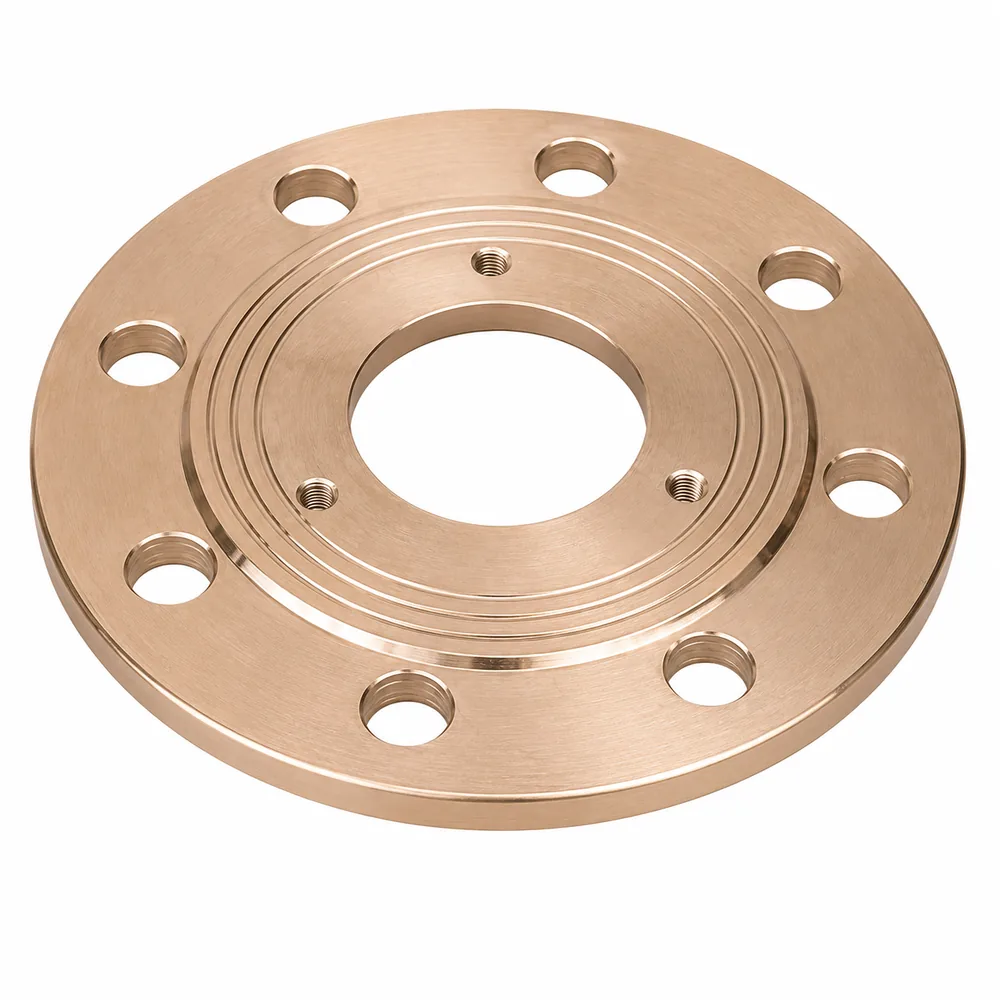
The facing on a flange determines how it seals. The two most discussed are raised face (RF) and ring-type joint (RTJ). They are not interchangeable, and the choice affects gaskets, machining and cost.
How raised face seals
An RF flange has a raised ring around the bore. A gasket sits on that raised area, and bolt load compresses it to seal. The gasket can be non-metallic, spiral-wound or metal-jacketed, depending on pressure and temperature.
How RTJ seals
An RTJ flange has a groove machined in its face. A metal ring, oval or octagonal in section, sits in the groove. As the bolts are tightened, the ring deforms against the groove walls and forms a metal-to-metal seal.
| Raised face (RF) | Flat face (FF) | Ring-type joint (RTJ) | |
|---|---|---|---|
| Sealing element | Soft or semi-metallic gasket on raised area | Full-face gasket | Metal ring in a machined groove |
| Typical pressure use | Moderate to high | Lower | Higher |
| Face machining | Standard | Simple | Precise groove |
| Gasket reuse | Replace each time | Replace each time | Replace the ring each time |
| Governing gasket standard | ASME B16.20 or B16.21 | ASME B16.21 | ASME B16.20 |
When RTJ is specified
- Higher-pressure joints on process and utility lines
- Joints with thermal cycling or pressure fluctuations
- Specifications that exclude non-metallic gaskets
- Matching existing RTJ equipment
Copper nickel: what to check
A ring joint relies on the ring being softer than the groove so the ring deforms instead of the flange. Copper-nickel is a comparatively soft flange material, so the ring material and hardness need engineering review. Do not assume a ring selection used with steel flanges will suit copper-nickel flanges.
Flat face and mixed pairs
Flat face flanges are used against flat faced equipment. Mating a flat face flange to a raised face flange creates bending stress when the bolts are tightened, which is a particular concern for brittle or low-strength materials. Check with your piping designer before mixing facings.
Ordering
State facing, ring number or groove standard, size and class when you enquire. See our pages on RTJ flanges and weld neck flanges for details, or contact us with your requirement.
FAQs
Is RTJ always better than RF?
No. RTJ suits higher-pressure or cyclic duty. RF is simpler and less costly and is adequate for many applications.
Can I reuse an RTJ ring?
Rings are normally replaced each time the joint is remade, because they deform when tightened.