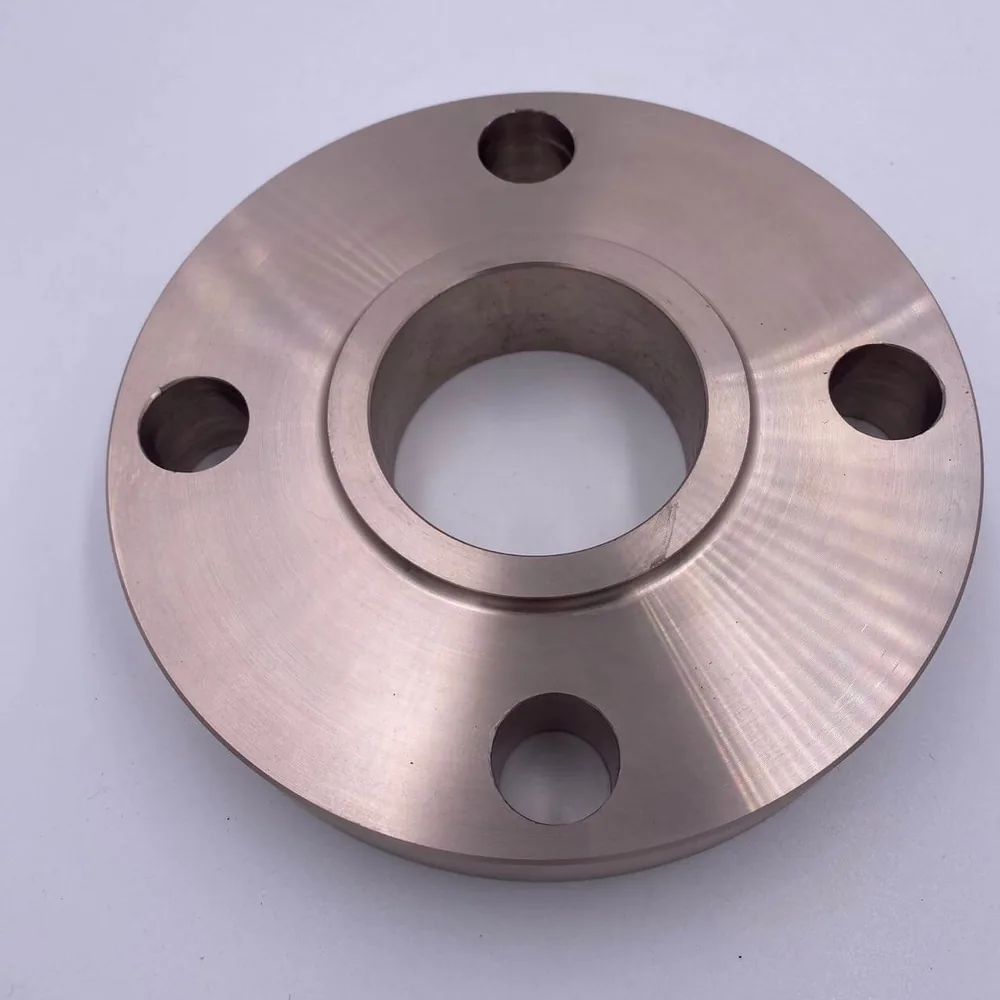
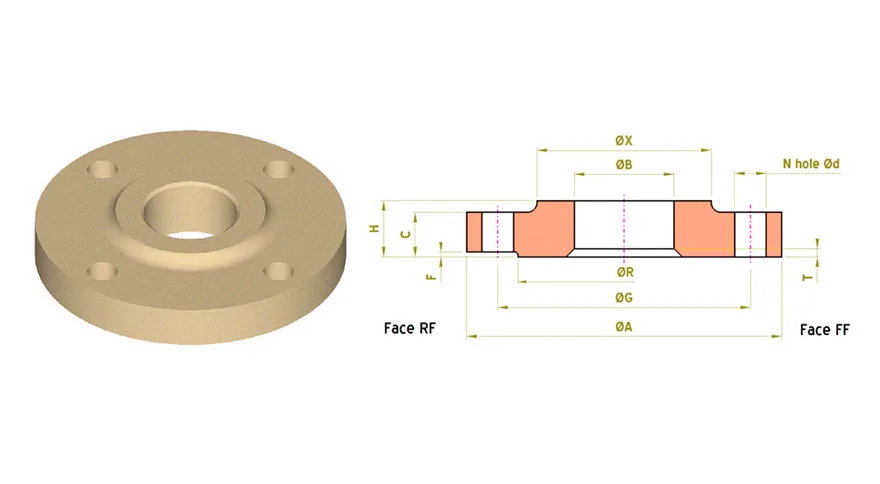
How a slip-on flange works
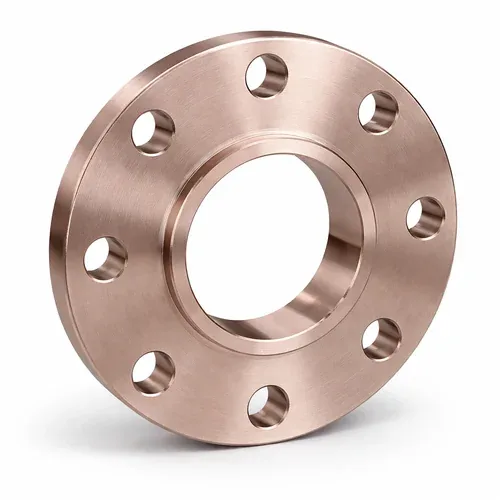
A slip-on (SO) flange has a bore slightly larger than the pipe outside diameter. The pipe slides into the flange, stops short of the face by a set distance, and is joined with two fillet welds: one at the hub or back of the flange and one on the inside, near the face.
The absence of a precisely machined weld bevel makes fit-up faster, and the flange is lighter and usually less costly than a weld neck of the same size.
Where slip-on flanges make sense in copper nickel
Slip-on flanges are widely used on seawater cooling water, fire-main branches, sanitary systems and general utility lines where operating pressure is moderate and cyclic loading is limited. They suit shop and site fabrication where the pipe length is trimmed to fit.
Designers often cite slip-on joints as having lower strength under internal pressure and shorter fatigue life than weld neck joints. If the line sees vibration, frequent thermal cycling or high consequence of leakage, a weld neck flange is usually the better specification.
Crevice and flow considerations
There is a small annular gap between the pipe and the flange bore. In flowing seawater this gap is usually benign, but in stagnant or intermittently used lines it can become a site for crevice attack. Where a line will sit full of stagnant seawater, or where the internal fillet weld cannot be made smooth, review the joint type with your piping designer.
Keeping the internal fillet weld clean and ground consistently helps limit turbulence at the joint, which matters because copper-nickel relies on a stable surface film.
Alloys, standards and drilling
Slip-on flanges are machined from Cu-Ni 90/10 (UNS C70600) or Cu-Ni 70/30 (UNS C71500) stock. Drilling and facing are typically referenced to ASME B16.5, with larger sizes to ASME B16.47. Material requirements are governed separately by the applicable ASTM or ASME specification, for example ASTM B151 for bar or ASTM B122 for plate.
- Facings: raised face (RF) and flat face (FF); RTJ is uncommon on slip-on flanges
- Drilling: to the standard or class stated in your enquiry
- Pressure class: as agreed against your design basis
- Sizes: available as per applicable standard and customer specification
Manufactured to applicable ASME/ASTM requirements based on project specification.
Welding the flange to the pipe
Both fillet welds are made with copper-nickel filler metal under a qualified procedure. Maintain the specified gap between the pipe end and the flange face so the face is not distorted or contaminated by weld spatter. Slip-on fillet welds cannot be examined by radiography as readily as a butt weld, so inspection is normally by visual and surface methods per your code.
Inspection and documentation
Dimensional checks, material identification and certification can be arranged against your purchase order. State whether you need an MTC, a dimensional report, a certificate of conformity, PMI or third-party inspection when you enquire; they are provided according to project requirements rather than on every order.
Details that help us quote accurately
- Alloy and material specification
- NPS, class and facing
- Pipe outside diameter, so the bore can be confirmed
- Quantity, delivery date and documentation list
Technical summary
Values below are references, not guarantees. Size range and pressure class depend on flange type, size, alloy and the applicable standard, and are confirmed against your specification at quotation.
| Item | Detail |
|---|---|
| Product type | Slip-on flange (SO) |
| Alloy options | Copper-Nickel 90/10 (UNS C70600) and Copper-Nickel 70/30 (UNS C71500) |
| Typical material forms | ASTM B151 rod and bar, ASTM B122 plate; other forms per project specification |
| Dimensional reference | ASME B16.5 / B16.47 typical; project drawing where supplied |
| Size range (NPS) | Available as per applicable standard and customer specification |
| Pressure class | Per applicable standard and design basis |
| Face / end type | RF, FF |
| Typical service | Seawater, cooling water, fire-main branches, utility piping |
| Documentation | Arranged according to project requirements (see Quality and Certifications) |
Copper nickel slip-on flange FAQs
Are slip-on flanges suitable for seawater service?
Yes, on lower-demand lines such as cooling water and utility piping. For lines with vibration, pressure cycling or higher consequence of failure, weld neck flanges are usually preferred.
How many welds does a slip-on flange need?
Two fillet welds, one on the outside at the back of the flange and one on the inside near the face.
Can slip-on flanges be supplied with a flat face?
Yes. Flat-face slip-on flanges are used where the mating flange or equipment connection is flat faced. State the facing at enquiry so the pairing can be checked.
Which standard do the dimensions follow?
Typically ASME B16.5 for NPS 1/2 to 24, or ASME B16.47 for larger diameters. If your project uses another dimensional standard, send it with the enquiry.