Composition and designations
Copper Nickel 90/10 is nominally 90% copper and 10% nickel, with small controlled additions of iron and manganese. The iron addition is deliberate: it improves resistance to erosion-corrosion in flowing seawater.
The wrought alloy is designated UNS C70600, and in European usage CuNi10Fe1Mn. Cast material of similar nominal composition has its own UNS designation and is covered by ASTM B369. Exact chemical limits are not repeated here, because the applicable ASTM or ASME material specification governs them for every order.
Corrosion resistance in seawater
In clean, flowing seawater, 90/10 forms a thin, adherent surface film that protects the metal and develops over the first weeks and months of service. The film is the reason the alloy performs well, and also the reason that flow conditions, cleanliness and commissioning practice matter.
Copper-nickel is not susceptible to chloride stress corrosion cracking, and it resists general corrosion and pitting in flowing seawater. Its copper content also discourages marine growth on wetted surfaces, though it is not a guarantee against fouling in stagnant conditions.
- Flowing, aerated seawater: good performance within design velocity limits
- Stagnant seawater: fouling and local attack can occur if lines are left full and idle
- Sulfide-polluted or contaminated water: can damage the film and accelerate attack
- Ammonia-bearing media and oxidizing acids: generally unsuitable
Erosion-corrosion and flow velocity
Every copper-nickel piping design sets a maximum flow velocity, because excessive velocity or turbulence can strip the protective film. The limit depends on pipe size, fittings, water quality and the design standard you follow. Flanges contribute by keeping the bore flush with the pipe so the joint is not a turbulence source.
If your design velocities are high, or the line has many abrupt changes in direction, consider whether Cu-Ni 70/30 is more appropriate.
Fabrication characteristics
90/10 is readily welded with matching copper-nickel filler metal using common arc processes under a qualified procedure. Joint surfaces must be clean, and contaminants such as sulfur-bearing materials, lead and zinc must be kept away from the weld area. It can be cold formed and machined, though it is not a free-machining alloy, and machining parameters are set to suit.
Typical industrial applications
- Seawater cooling and circulation lines
- Shipboard seawater, firewater and ballast systems
- Offshore platform utility and firewater systems
- Desalination plant seawater-side piping
- Coastal power-plant auxiliary cooling water
- Heat-exchanger connections on seawater-cooled equipment
Comparison with other copper alloys
Copper-nickel competes with other copper-based alloys in marine duty. This is a qualitative guide only; selection is a design decision for your materials engineer.
| Alloy family | Strengths | Points to watch |
|---|---|---|
| Cu-Ni 90/10 | Seawater piping standard; good corrosion and fouling behavior; immune to chloride SCC | Velocity limits; sulfide pollution; stagnant fouling |
| Cu-Ni 70/30 | Higher strength and velocity tolerance | Higher cost than 90/10 |
| Nickel aluminum bronze | High strength; widely cast for pumps, valves and propellers | Less common for piping flanges; fabrication and heat treatment need care |
| Naval and admiralty brasses | Lower cost; historic use in condenser tubes and marine hardware | Dezincification risk in seawater unless inhibited |
Cu-Ni 90/10 flange types we manufacture
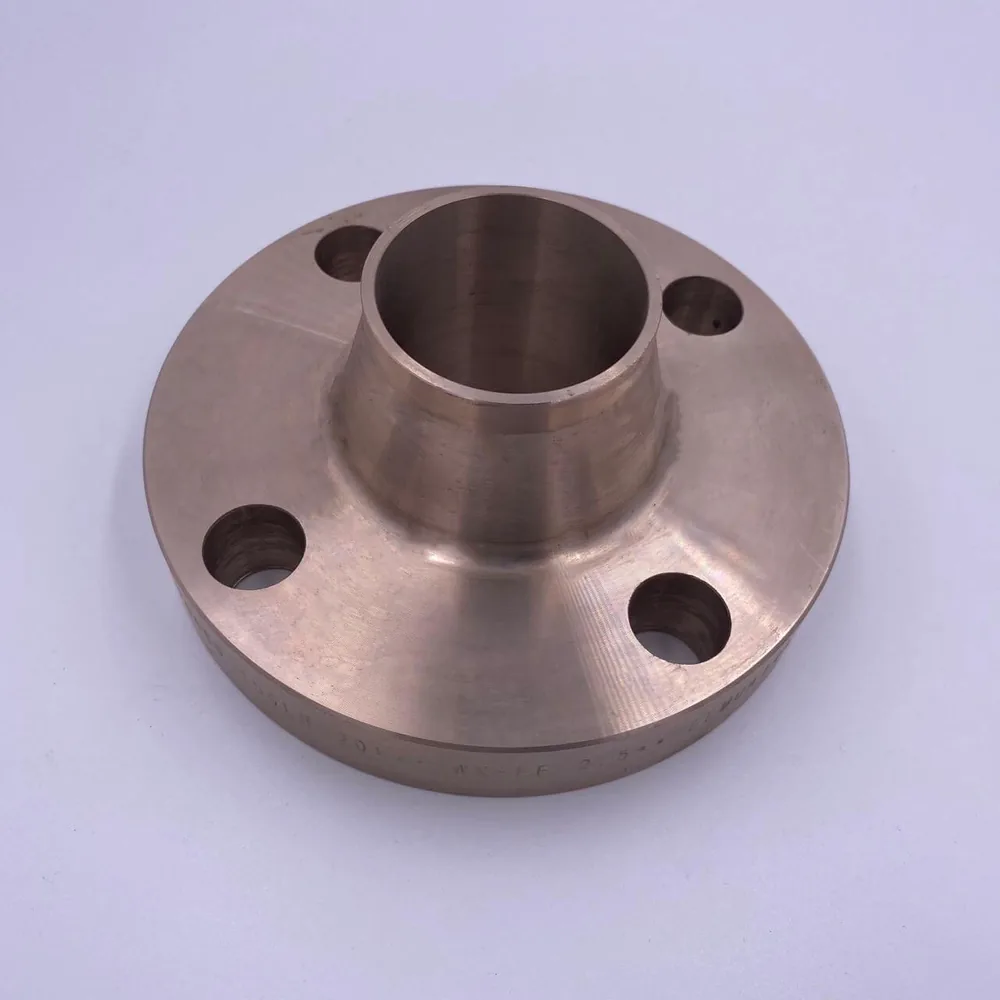
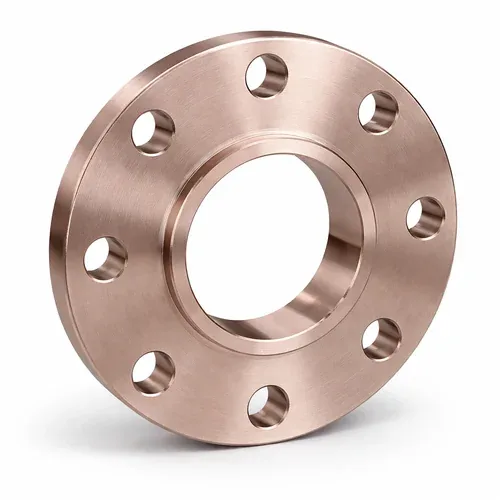
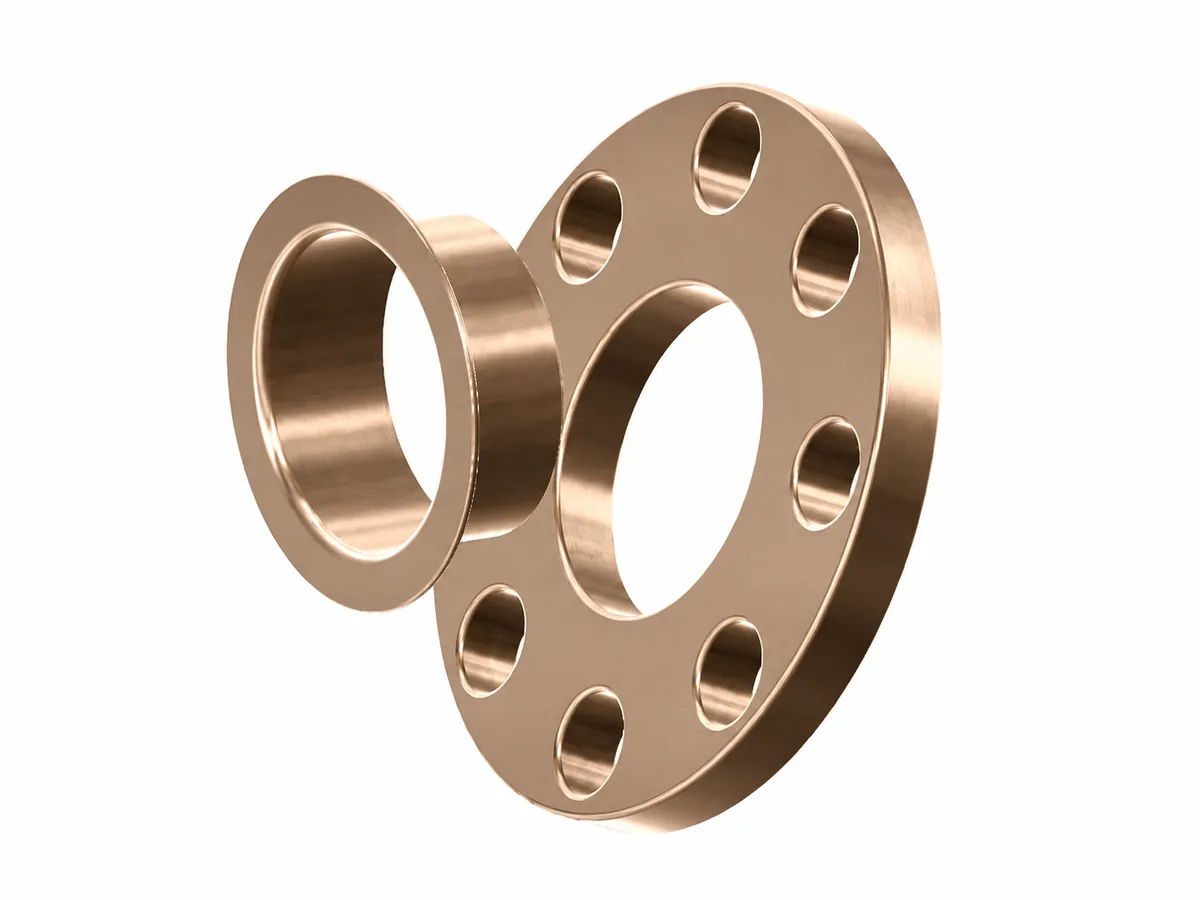
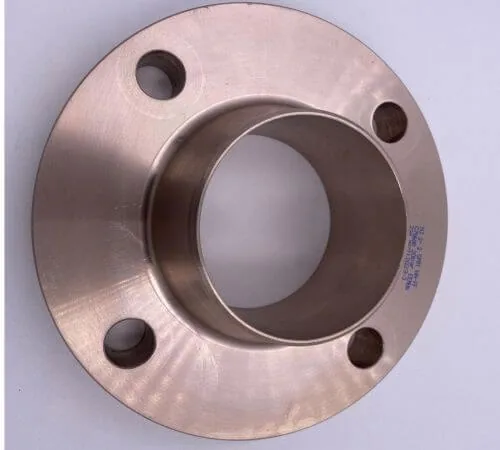
We machine 90/10 flanges in all the configurations below. Each page sets out the construction, standards references and enquiry details for that type.
- Copper nickel weld neck flanges
- Copper nickel slip-on flanges
- Copper nickel blind flanges
- Copper nickel socket weld flanges
- Copper nickel threaded flanges
- Copper nickel lap joint flanges
- Copper nickel composite flanges
- Copper nickel orifice flanges
- Copper nickel spectacle blind flanges
- Copper nickel rtj flanges
- Copper nickel expander flanges
- Copper nickel custom manufacturing flanges
Technical reference
Where exact chemistry or mechanical values matter, the applicable ASTM or ASME material specification governs. Those values are not restated here.
| Item | Detail |
|---|---|
| Alloy | Copper-Nickel 90/10 |
| Wrought UNS designation | C70600 |
| European designation | CuNi10Fe1Mn |
| Common product-form specifications | ASTM B151 (rod and bar), ASTM B122 (plate, sheet, strip), ASTM B466 (seamless pipe and tube), ASTM B467 (welded pipe), ASTM B369 (castings, cast equivalent) |
| Chemical composition | As defined by the applicable ASTM or ASME specification |
| Mechanical properties | Depend on product form and temper; as defined by the applicable specification |
| Approximate density | 8.9 g/cm³ (0.32 lb/in³) |
| Weldability | Weldable with matching copper-nickel filler metal under a qualified procedure |
| Flange standards referenced | ASME B16.5, ASME B16.47, ASME B16.48 and others per project specification |
| Documentation | MTC, dimensional report, certificate of conformity, PMI, third-party inspection per project requirements |
90/10 and 70/30 compared
| Property | Cu-Ni 90/10 | Cu-Ni 70/30 |
|---|---|---|
| Nominal composition | 90% copper, 10% nickel, with controlled iron and manganese | 70% copper, 30% nickel, with controlled iron and manganese |
| Wrought UNS designation | C70600 | C71500 |
| Strength and hardness | Lower | Higher |
| Tolerance of high flow velocity and impingement | Good; set by design velocity limits | Better than 90/10; set by design velocity limits |
| Relative material cost | Lower | Higher (more nickel) |
| Typical flange use | General seawater piping, cooling water, firewater, ballast | Higher-velocity or more demanding duty, or to match 70/30 pipe and tube |
Read the full alloy comparison article for selection guidance.
Copper Nickel 90/10 flange FAQs
What is the UNS number for copper nickel 90/10?
The wrought alloy is UNS C70600. Cast material of similar nominal composition has a different designation under ASTM B369.
Is 90/10 suitable for seawater flanges?
Yes, it is the most common alloy for seawater piping flanges, provided flow velocity, water quality and commissioning practice stay within the design basis.
What is the difference between 90/10 and 70/30?
70/30 has more nickel, higher strength and better tolerance of high flow velocity. It also costs more. See the full alloy comparison.
Which standard sets the chemistry?
The applicable ASTM or ASME material specification governs chemistry and mechanical requirements. We confirm it against your purchase order.