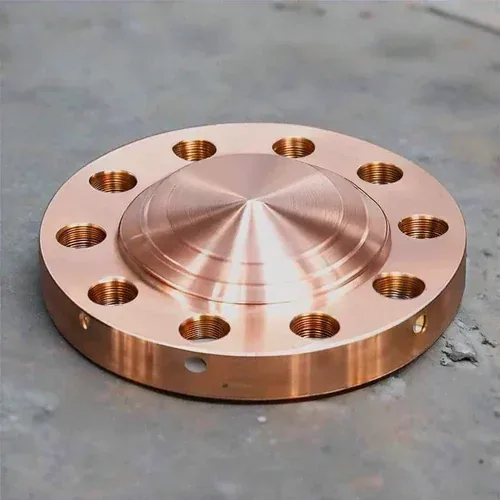
What a blind flange does
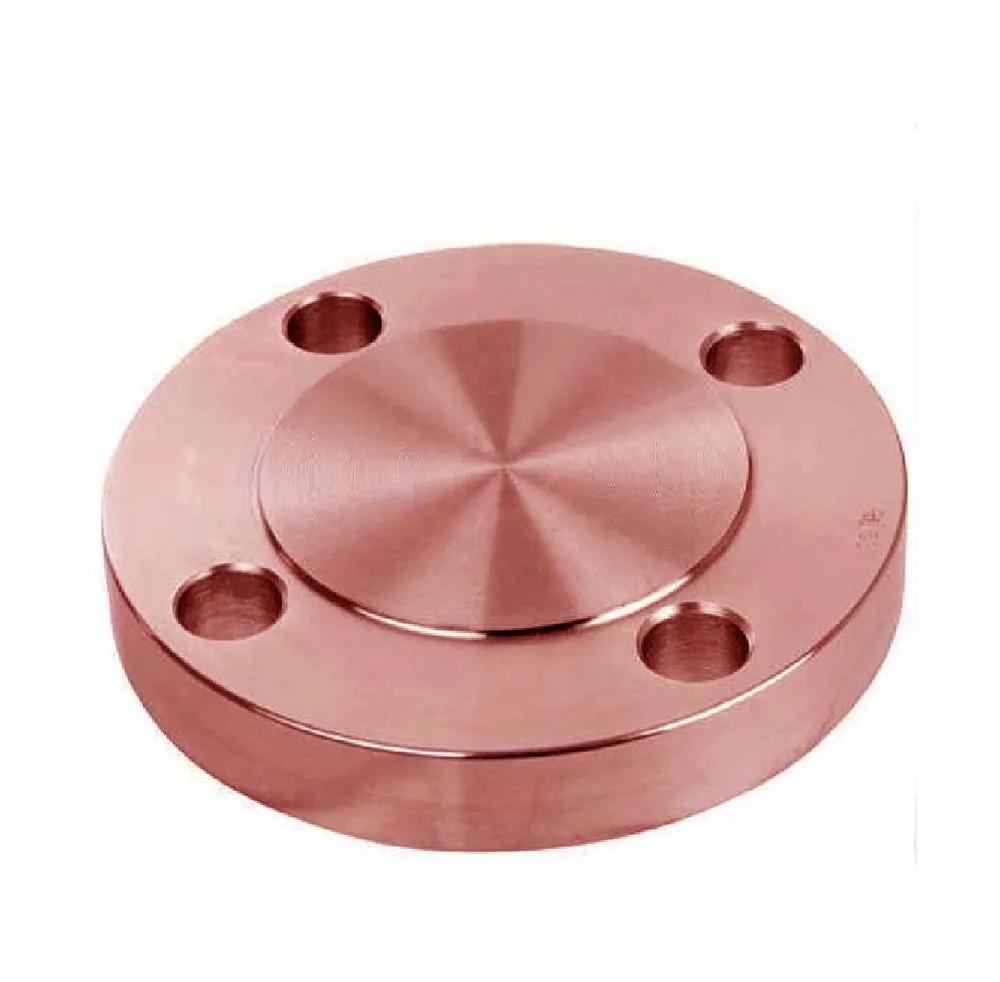
A blind flange is a solid disc drilled with the same bolt pattern as the flange it mates to. It terminates a line, closes a nozzle, or provides a removable cover for inspection and future expansion.
Unlike other flange types, a blind flange carries the full pressure load across its face. The plate behaves like a loaded disc in bending, so thickness is the critical design variable.
Thickness, facing and surface finish
Blind flange thickness is determined by the dimensional standard or by calculation for your design pressure and temperature. For copper-nickel the relevant allowable stress comes from the governing code, not from carbon-steel tables, so please send your design basis if thickness is not fixed by a standard table.
The sealing face is machined for the gasket type in your specification. Raised face is most common; flat face and RTJ grooves are available where required. Gasket-seating surface finish follows ASME B16.5 or your project specification.
- Facings: RF, FF, RTJ on request
- Bolt circle and hole size: matched to the mating flange
- Optional tapped connections for drains or instruments, per drawing
Typical uses in copper nickel systems
- End closures on seawater circulation headers
- Covers on heat-exchanger channels and water boxes
- Spare nozzles and future tie-in points on offshore and marine systems
- Hydrostatic test closures during commissioning
- Isolation points where a spectacle blind is not required
Large-diameter blind flanges
Big blind flanges are heavy, and copper-nickel stock is expensive, so material form and machining allowance matter. Large diameters are typically dimensioned to ASME B16.47 or a project drawing. Provide the diameter, bolt circle and drilling early so the stock form can be planned.
Alloys and standards
Blind flanges are machined from Cu-Ni 90/10 (UNS C70600) or Cu-Ni 70/30 (UNS C71500). Dimensions are typically referenced to ASME B16.5 for NPS 1/2 to 24 and ASME B16.47 above that. The material specification, for example ASTM B122 plate or ASTM B151 bar, sets chemistry and mechanical requirements, and any inspection scope comes from your purchase order.
Manufactured to applicable ASME/ASTM requirements based on project specification.
Inspection and documentation
Dimensional inspection, facing checks and material identification can be arranged. MTCs, dimensional reports, certificates of conformity and third-party inspection are available according to project requirements.
Information we need to quote
- Alloy, NPS or outside diameter, class and facing
- Drilling standard or bolt circle drawing
- Design pressure and temperature if thickness is to be calculated
- Quantity, delivery date and documentation requirements
Technical summary
Values below are references, not guarantees. Size range and pressure class depend on flange type, size, alloy and the applicable standard, and are confirmed against your specification at quotation.
| Item | Detail |
|---|---|
| Product type | Blind flange (BL) |
| Alloy options | Copper-Nickel 90/10 (UNS C70600) and Copper-Nickel 70/30 (UNS C71500) |
| Typical material forms | ASTM B151 rod and bar, ASTM B122 plate; other forms per project specification |
| Dimensional reference | ASME B16.5 / B16.47 typical; calculated or drawing-based thickness where required |
| Size range (NPS) | Available as per applicable standard and customer specification |
| Pressure class | Per applicable standard and design basis |
| Face / end type | RF, FF; RTJ on request |
| Typical service | Header ends, nozzle covers, test closures, future tie-ins |
| Documentation | Arranged according to project requirements (see Quality and Certifications) |
Copper nickel blind flange FAQs
Why are blind flanges thicker than other flanges of the same class?
The flange carries the full pressure load across a solid face and acts like a loaded disc, so more thickness is needed than for a ring flange with a bore.
Can you drill and tap a blind flange?
Yes, tapped holes for drains, vents or instruments can be added per drawing. Please state thread type and location.
What is the difference between a blind flange and a spectacle blind?
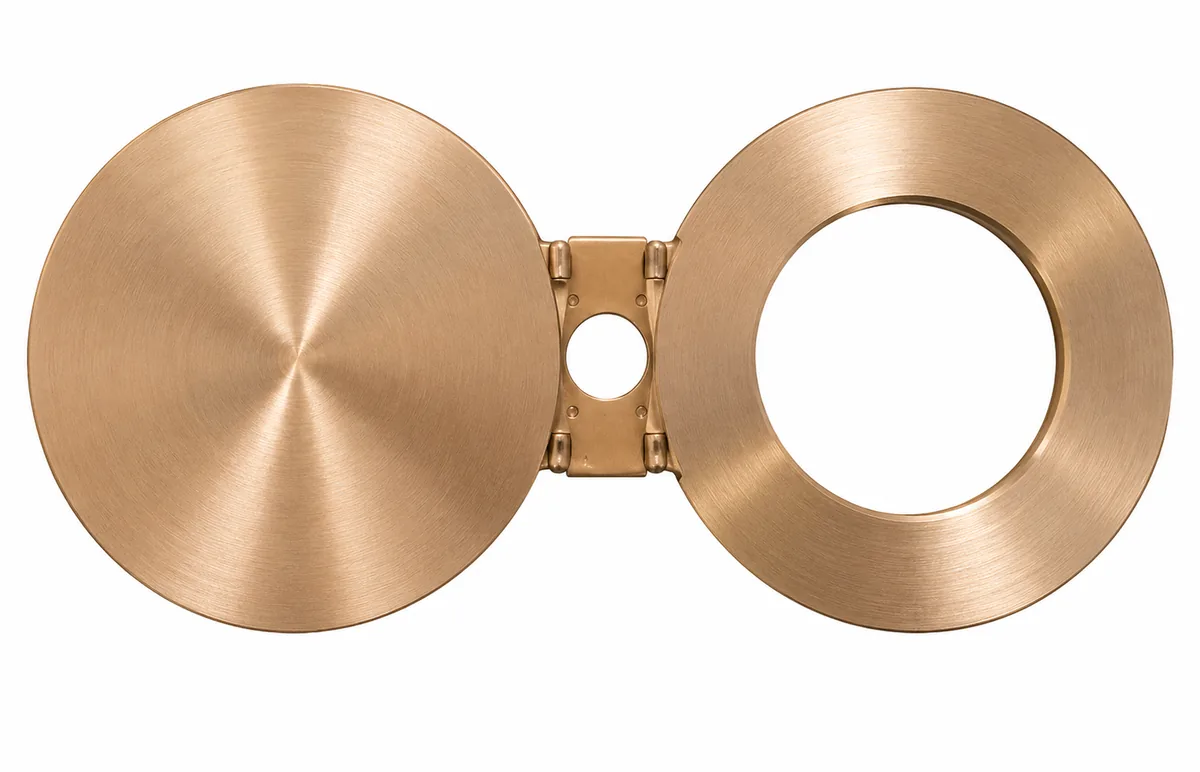
A blind flange closes a line end permanently or for long periods. A spectacle blind sits between two flanges and can be rotated to open or close the line without removing it.
Do large blind flanges follow ASME B16.5?
ASME B16.5 covers NPS 1/2 to 24. Above NPS 24, ASME B16.47 or a project drawing is normally used.