
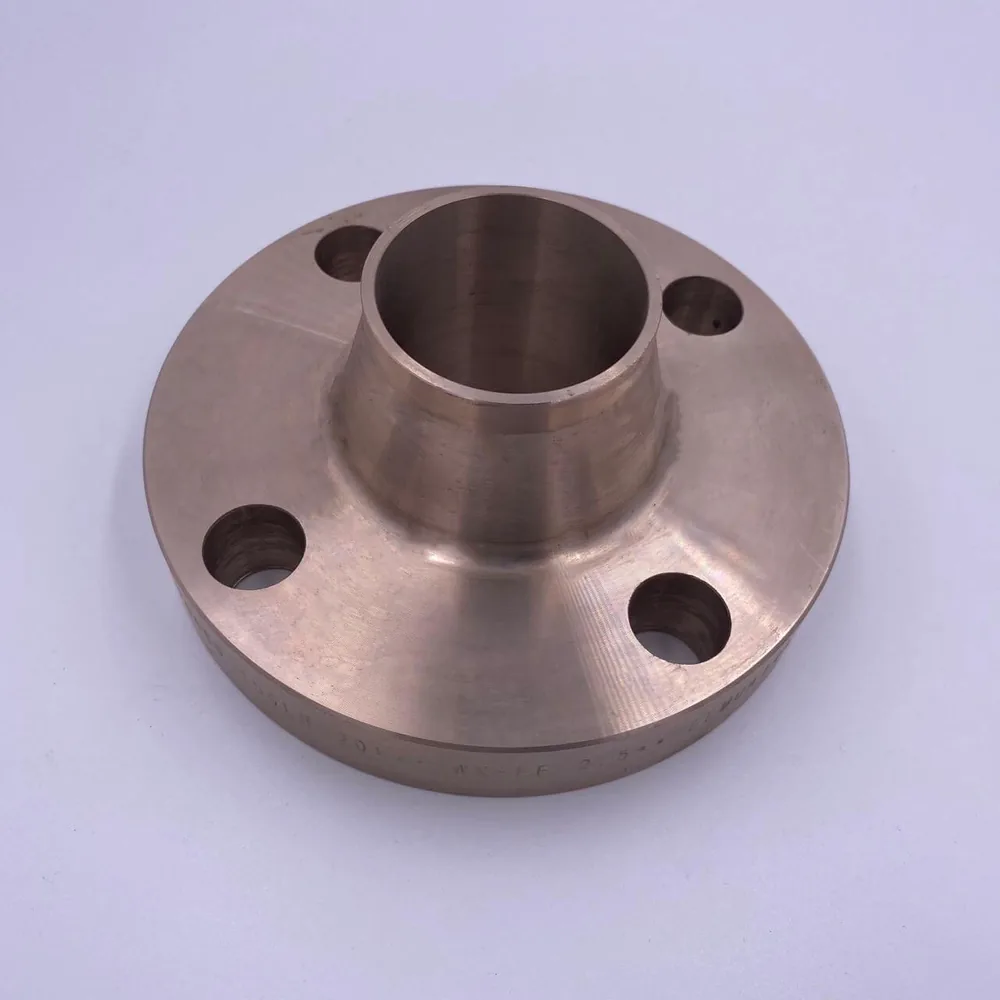
Copper-nickel 90/10 is the alloy most buyers meet first. This article covers where it is used and what to state so the quotation matches what you need. For the full metallurgy, see our Copper Nickel 90/10 page.
Characteristics that matter to a buyer
- Seawater behavior: forms a protective film in flowing, aerated seawater
- Fouling: discourages marine growth on wetted surfaces
- Cracking: not susceptible to chloride stress corrosion cracking
- Fabrication: weldable with matching filler metal; can be machined and formed
- Limits: velocity limits apply; sulfide pollution and ammonia-bearing media are problems
Where 90/10 flanges are used
- Seawater cooling and circulation systems on ships and platforms
- Firewater and ballast lines
- Desalination seawater-side piping
- Coastal power-plant auxiliary cooling
- Heat-exchanger connections on seawater-cooled equipment
Common flange types include weld neck, slip-on, blind and lap joint flanges.
Writing a complete specification
| Item to specify | Example |
|---|---|
| Alloy and UNS | Copper-Nickel 90/10, UNS C70600 |
| Material specification and form | For example ASTM B151 bar or ASTM B122 plate |
| Flange type | Weld neck, slip-on, blind, lap joint and so on |
| NPS and class | For example NPS 6, Class 150 |
| Facing | RF, FF or RTJ |
| Dimensional standard | For example ASME B16.5 |
| Documentation | MTC, dimensional report, certificate of conformity, PMI, third-party inspection as needed |
Common specification mistakes
- Stating only "90/10" without a material specification or product form
- Assuming pressure rating from carbon-steel flange tables
- Omitting pipe wall thickness for weld neck flanges
- Not stating documentation until after order placement
Next step
Send your requirement with the items above, or upload a drawing if the flange is non-standard.
FAQs
What should I state besides 90/10?
The UNS designation, material specification and form, flange type, NPS, class, facing, standard and documentation requirements.
Is 90/10 right for every seawater line?
Not always. High velocities or demanding duty may favor 70/30. Confirm with your design basis.