
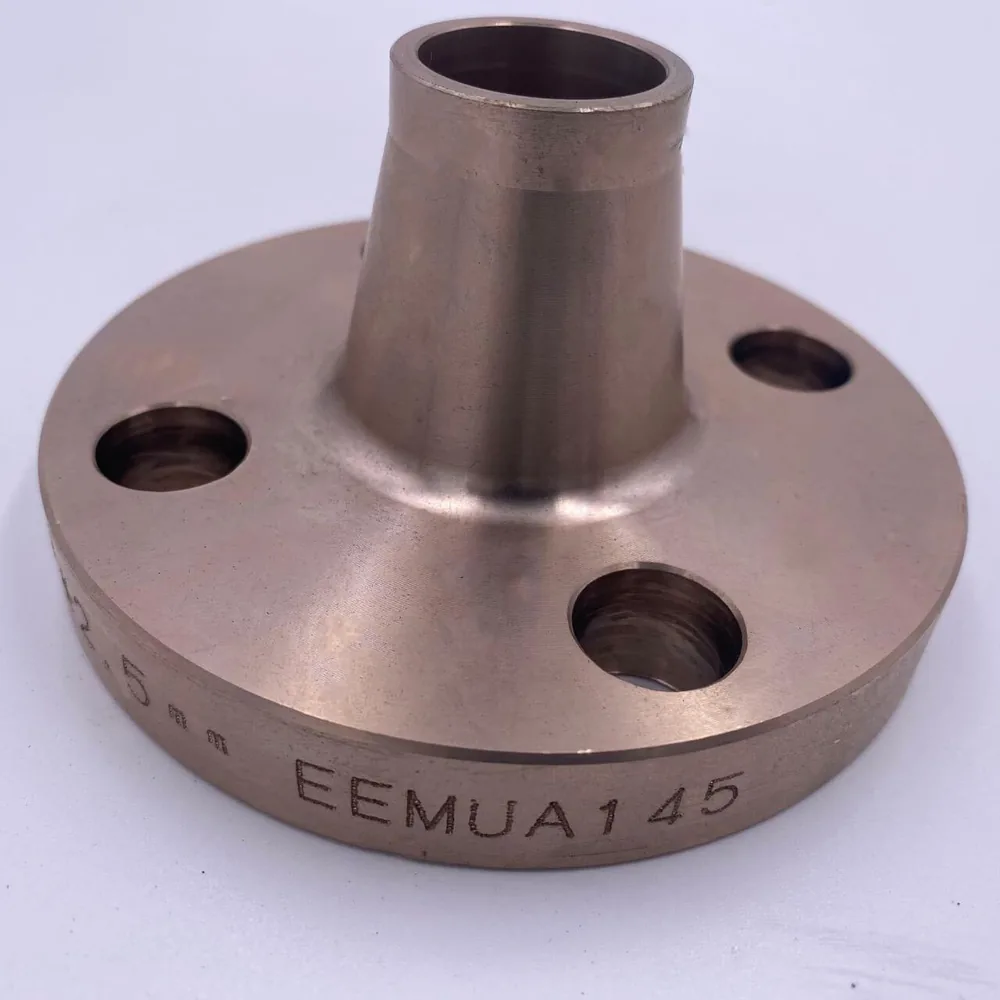
If you are specifying copper nickel flanges, the first question is nearly always the same: 90/10 or 70/30? Both alloys resist seawater corrosion through a protective surface film. They differ in nickel content, strength, tolerance of flowing water and price.
The short answer
Choose Cu-Ni 90/10 for general seawater piping, cooling water, firewater and ballast systems where velocities stay inside design limits. Choose Cu-Ni 70/30 when duty is more demanding, velocities are higher, or the connected pipe and heat exchangers are already 70/30.
Composition and designations
Cu-Ni 90/10 is nominally 90% copper and 10% nickel, with controlled iron and manganese. Its wrought designation is UNS C70600. Cu-Ni 70/30 is nominally 70% copper and 30% nickel with iron and manganese, designated UNS C71500. The applicable ASTM or ASME material specification governs exact chemistry for both.
Side-by-side comparison
| Consideration | Cu-Ni 90/10 | Cu-Ni 70/30 |
|---|---|---|
| Nominal composition | 90% Cu, 10% Ni, with iron and manganese | 70% Cu, 30% Ni, with iron and manganese |
| Wrought UNS designation | C70600 | C71500 |
| Strength and hardness | Lower | Higher |
| Tolerance of high velocity and turbulence | Good within design limits | Better than 90/10 within design limits |
| Material cost | Lower | Higher |
| Typical flange use | General seawater, cooling water, firewater, ballast | Demanding duty, high velocity, or matching 70/30 equipment |
When 90/10 is enough
Most seawater piping systems are designed around 90/10. It is the more economical alloy, has a long record in marine piping, and performs well in flowing seawater when the design velocity limits are respected. If your specification calls for 90/10, there is no technical reason to upgrade without a stated service reason.
When 70/30 earns its cost
- Lines with high flow velocity, many fittings or turbulence at pump discharges and bends
- Connections to 70/30 heat-exchanger tubes, tubesheets or pipe, so the circuit shares one alloy
- Designs where higher strength allows lighter sections
- Specifications that call for 70/30 by name, as in some naval and offshore work
What neither alloy fixes
Both alloys are damaged by sulfide-polluted water, both are unsuited to ammonia-bearing media and oxidizing acids, and both can suffer in stagnant seawater if the line is left full and idle. Choosing 70/30 does not remove the need for sound commissioning and operating practice. See our guide to copper nickel flanges for seawater piping systems.
Match the whole system
A flange is one part of the circuit. If the pipe is 90/10, 90/10 flanges are the natural match. If a spool is 70/30, use 70/30 flanges so you avoid a mixed-alloy joint. Mixed 90/10 and 70/30 joints are possible, but they are a design decision rather than a default.
How to decide
- Start from the alloy in the piping specification and heat-exchanger datasheets
- Check design velocity at the flange locations, including pump discharge
- Confirm the material specification and product form (for example ASTM B151 or B122)
- Ask about price difference for your sizes before committing
Not sure which applies? Send us your requirement and we will quote the alloy you specify, or review the options with you.
FAQs
Is 70/30 always better than 90/10?
No. 70/30 is stronger and more tolerant of high velocity, but also costs more. Many seawater lines are designed around 90/10 and perform well.
Can 90/10 and 70/30 be mixed in one piping system?
Yes, but it is a design decision. Many designers prefer to keep one alloy per circuit.
Which UNS numbers apply?
C70600 for wrought 90/10 and C71500 for wrought 70/30. Cast equivalents have separate designations.