
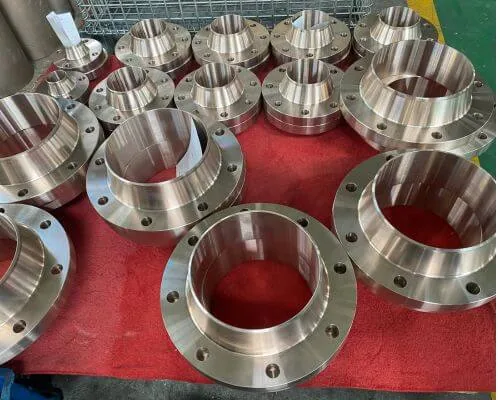
Ships, platforms and coastal plants move seawater through piping every day. Copper-nickel has been a standard material for that job for decades, and the reasons are specific.
A protective film in seawater
In flowing, aerated seawater, copper-nickel forms a thin surface film that slows further corrosion. That film is the foundation of its performance, and is why flow velocity and commissioning practice are part of the design.
Resistance to biofouling
Copper released from the surface discourages marine growth on wetted surfaces. In seawater systems that matters, because fouling reduces flow and heat transfer. It does not make copper-nickel fouling-proof, and stagnant conditions can still allow growth.
No chloride stress corrosion cracking
Chloride-rich environments crack some stainless steels under stress. Copper-nickel does not suffer from chloride stress corrosion cracking, which removes one failure mode from the design.
Fabrication
Copper-nickel can be welded with matching filler metals, formed and machined. That means flanges, stub ends, pipe and fittings can all be made in the same alloy, and the corrosion behavior is consistent from pipe to joint.
Where it is used
- Shipboard seawater cooling, ballast and firewater systems
- Offshore platform seawater and utility systems
- Desalination plant seawater-side piping
- Coastal power-plant cooling water
- Seawater-cooled heat exchangers
See our applications page for each industry.
Where it is not the right choice
Copper-nickel is not suited to ammonia-bearing media, oxidizing acids or sulfide-rich streams, and it is not normally specified for sour hydrocarbon process lines. High-pressure reverse osmosis systems typically use other alloys. Always confirm the fluid and conditions.
Choosing the alloy
Cu-Ni 90/10 is the usual choice for general seawater piping, and Cu-Ni 70/30 for more demanding duty. Our alloy comparison explains the trade-offs.
FAQs
Does copper nickel prevent fouling completely?
No. It discourages marine growth, but stagnant conditions can still allow fouling.
Is copper nickel used in reverse osmosis systems?
High-pressure RO systems generally use other alloys. Thermal desalination uses copper-nickel in seawater-side equipment.