
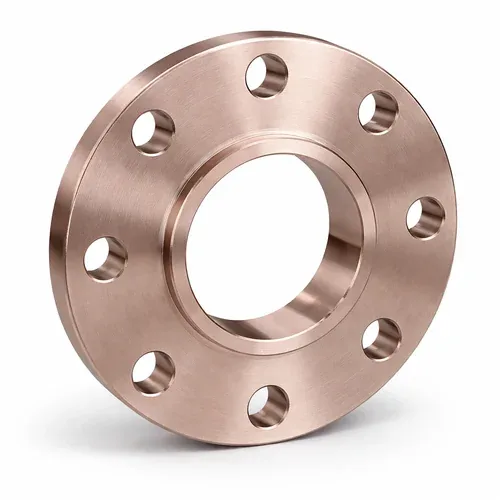
Slip-on and weld neck flanges both connect pipe to flanged joints. They differ in how they are welded, how they carry load and what they cost. The right choice depends on service, not habit.
| Weld neck | Slip-on | |
|---|---|---|
| Weld type | One full-penetration butt weld | Two fillet welds |
| Bore | Matches pipe bore | Larger than pipe OD; annular gap |
| Fatigue and vibration | Better; tapered hub spreads stress | Generally lower |
| Radiography of weld | Practical | Difficult for fillet welds |
| Fit-up | Needs precise bevel and alignment | Easier; pipe slides in |
| Cost | Higher | Lower |
| Typical use | Critical, cyclic or high-consequence lines | Lower-demand utility and cooling lines |
The case for weld neck
The tapered hub transfers load gradually, and the bore matches the pipe. In copper-nickel seawater lines this means less turbulence at the joint and better behavior under vibration and thermal cycling. If the weld will be radiographed, a butt weld is the practical choice. See weld neck flanges.
The case for slip-on
A slip-on flange is quicker to fit, cheaper and tolerant of small length errors. For moderate pressure, limited cycling and non-critical duty, it is a sensible choice. See slip-on flanges.
Points specific to copper nickel
- The annular gap behind a slip-on fillet weld can be a stagnation point. In idle seawater lines, consider whether that is acceptable.
- The internal fillet weld should be smooth to limit turbulence, because copper-nickel relies on a stable surface film.
- Weld neck flanges cost more in material because of the hub, which matters when copper-nickel stock is expensive.
Rules of thumb
- Critical, cyclic or vibrating line: weld neck
- Lower-demand cooling or utility line, easy fit-up wanted: slip-on
- Frequent dismantling: consider lap joint
- Specification names one: follow it
Need help? Send your line details and we will quote either type.
FAQs
Is slip-on weaker than weld neck?
Slip-on joints are generally regarded as having lower strength and fatigue life than weld neck joints, which is why weld neck is preferred for critical lines.
Which is cheaper in copper nickel?
Slip-on flanges are usually less costly, partly because they use less material and are simpler to machine.