
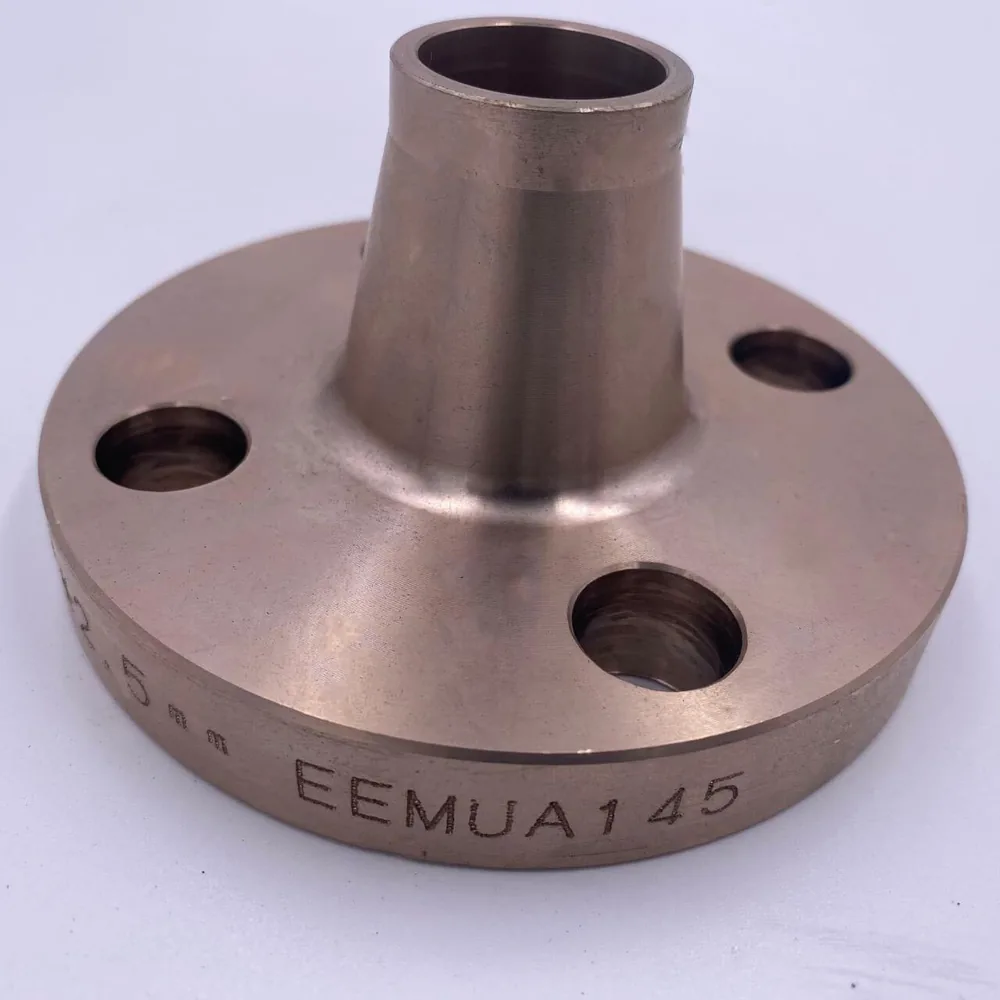
Cu-Ni 70/30 contains about 30% nickel. In marine service it is used in the places where a seawater line works hardest. This guide covers those places and the specification points that go with them.
Hot spots in a seawater line
Velocity and turbulence are not uniform along a line. They peak at pump discharges, after bends, at reducers and valves, and around partially open isolation devices. Those locations are where designers consider the higher flow tolerance of 70/30.
- Pump discharge flanges and the first fittings downstream
- Flanges at reducers and expanders (see expander flanges)
- Heat-exchanger inlet and outlet nozzles
- Flow-metering points (see orifice flanges)
Matching the system alloy
Heat-exchanger tubes and tubesheets are frequently 70/30. If the nozzle flanges and the connected pipe are also 70/30, the corrosion behavior is consistent throughout the circuit. That is often the deciding reason to use 70/30 flanges.
Marine and naval specifications
Specialist marine and naval projects often call for 70/30 by designation and add documentation requirements. Send the specification at enquiry. We will review its material, inspection and certification clauses before quoting.
Welding and fabrication
70/30 is welded with matching copper-nickel filler metal under a qualified procedure, with clean joint surfaces. For weld neck flanges, provide pipe wall thickness so the bevel can be prepared correctly. See weld neck flanges.
What to state when you order
- Alloy and UNS designation (C71500)
- Material specification and product form
- Flange type, NPS, class and facing
- Required inspection and documents
Still choosing?
If you are comparing alloys, read 90/10 vs 70/30, or contact our team with your requirement.
FAQs
Is 70/30 used throughout a seawater system?
Sometimes. Many systems use 90/10 generally and 70/30 at demanding points or where connected equipment is 70/30.
Do you quote against naval specifications?
Send the specification with your enquiry. We will review its requirements before quoting.